TL;DR — Key Points
- Grade selection is a procurement decision, not a cosmetic one — the wrong grade has direct consequences for yield, cost, and product appearance.
- Bakery Grade (650–700 pcs/oz): bread inclusion, granola, muesli — functional applications where colour uniformity is not required.
- Premium Bakery Grade (550–600 pcs/oz): artisan bread toppings, premium granola, protein bars — larger kernel, optically sorted.
- Confectionery Grade (500–550 pcs/oz): coated snacks, retail packs, trail mixes — pure white to light-cream colour only.
- Chips: oil pressing, bar inclusions, feed — broken kernel fraction, 42–48% oil.
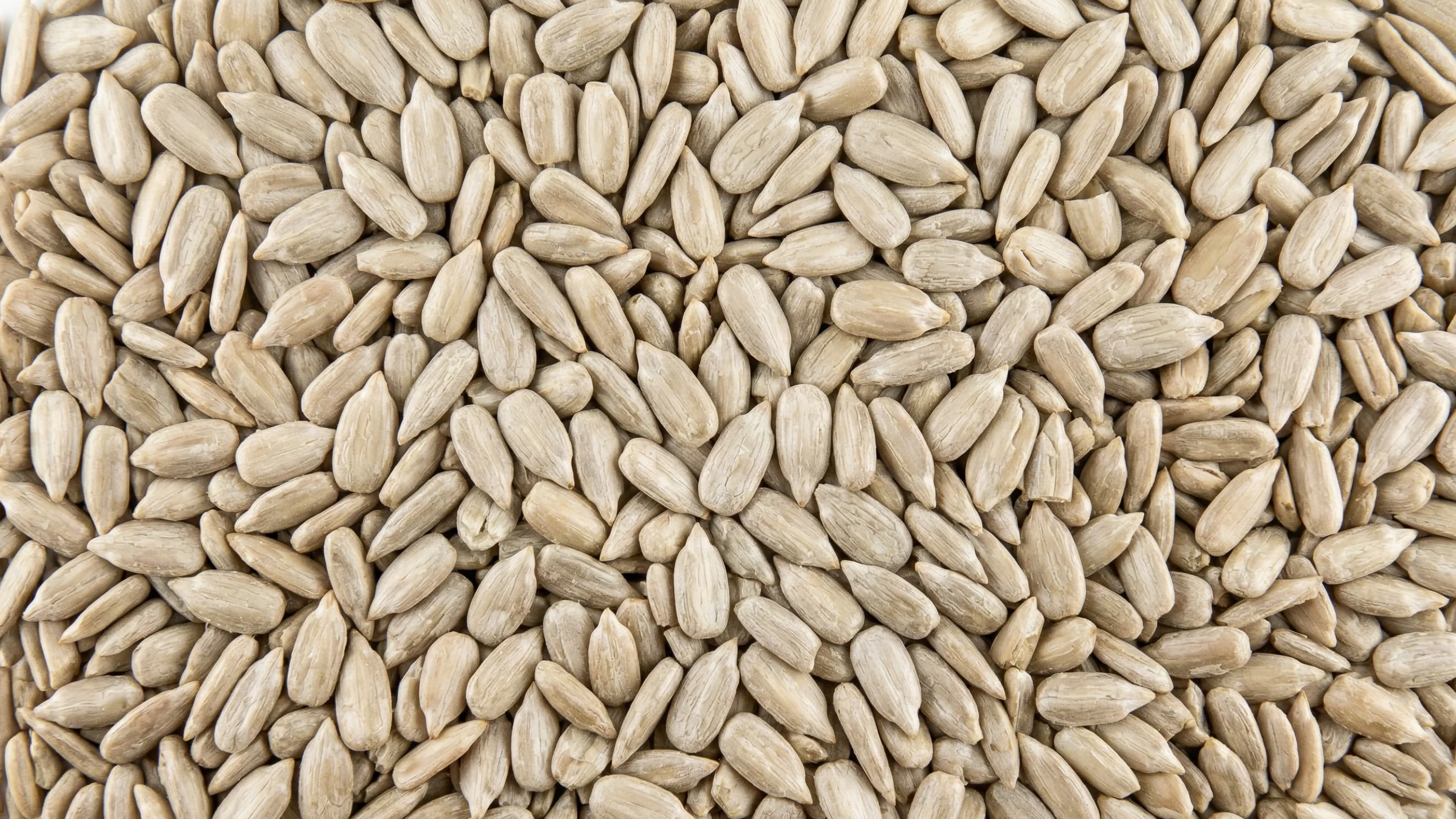
Four grades. Near-identical photographs. A price spread of 15–30% between the cheapest and the most expensive. And consequences that reach far past the invoice. A confectionery producer ordering Bakery Grade to save cost discovers, mid-production run, that the kernel colour variance — perfectly acceptable for a bread inclusion — triggers an automated rejection on the optical sorter feeding a chocolate-coating line. A bakery specifying Confectionery Grade for a dense multigrain loaf pays a significant premium for optical sorting and colour uniformity that disappears entirely inside the crumb. Neither outcome is the supplier's fault. Both are specification failures.
How Sunflower Kernels Are Graded
Grading begins in the field and is completed on the processing line. After harvest, sunflower heads are cleaned, dried, and hulled. The hulled kernels pass through calibration screens that segregate by size, expressed in pieces per ounce (pcs/oz): a lower number means a larger average kernel. A kernel count of 500 pcs/oz yields a visibly larger piece than one at 700 pcs/oz.
From calibration, kernels move through a gravity separator — to remove shrivelled or incompletely filled pieces — and, for upper grades, through optical sorting: multi-pass colour cameras and air-jet ejectors that remove darkened, off-colour, or blemished kernels. It is the optical-sorting pass that most significantly differentiates Confectionery Grade from Bakery Grade, and that accounts for much of the price differential.
The specifications that drive grade classification are: size calibration (pcs/oz range), broken-kernel percentage, colour tolerance, purity (% kernel by weight), oil content, and moisture. Each of these has direct downstream relevance — not merely quality-assurance significance.
Bakery Grade — The Working Specification
Specification: 650–700 pcs/oz | 99.98% purity | 45–50% oil content | max 8% moisture | max 8% broken kernels
At 650–700 pcs/oz, Bakery Grade kernels are mid-size — consistent enough for even distribution in a dough matrix or on a bread crust, but without the tight optical sorting of upper grades. The colour profile permits natural variation into amber tones and light spotting, which is invisible once baked.
Ideal for: Bread-crust toppings on rye, multigrain, and sourdough; cracker and flatbread dough inclusions; muesli and granola blends where kernels are combined with darker-coloured oats and seeds; trail mixes where retail colour uniformity is not the dominant SKU proposition; commercial bakery ingredient streams.
Not suited for: Any application where the kernel is the centrepiece visually — chocolate coating, retail snack pack topping, or exposed confectionery surface. The 8% broken-kernel allowance is also significant: for applications where fragmentation is visible in the finished product, a tighter spec is warranted.
Value position: This is the correctly-priced grade for high-volume inclusion applications. Specifying above this for bread or granola adds cost without functional return.
Premium Bakery Grade — Larger Kernel, Optically Sorted
Specification: 550–600 pcs/oz | extra-large kernel | optically sorted | max 8% moisture
Premium Bakery Grade closes the gap between functional baking ingredient and retail-visible garnish. The 550–600 pcs/oz range yields a noticeably larger kernel — visually distinct on an open-crumb bread or an artisan loaf where the topping is a deliberate design element. The optical-sorting step removes colour outliers and shrivelled pieces, producing a more consistent appearance without reaching the strict colour standard of Confectionery Grade.
Ideal for: Artisan bread and bakery products where the kernel topping is a deliberate selling point; high-visibility sandwich loaves in retail packaging; premium granola and muesli targeted at the upper market tier; protein and energy bars where kernel visibility is part of the product's quality signalling; food-service ingredient streams with a larger-kernel specification.
Not suited for: Applications requiring the pure-white to light-cream colour range of Confectionery Grade. If your chocolate-coating or confectionery production requires absolute colour uniformity, this grade will produce rejects. Equally, if kernel size is irrelevant to your process — a multigrain bread formula in which the kernel is one of seven inclusions — you are paying for size you do not need.
Value position: Approximately 10–20% above Bakery Grade depending on market conditions. Justified where either kernel size or optical consistency is a visible product attribute.
Confectionery Grade — Strictest Specification in the Range
Specification: 500–550 pcs/oz | 99.99% purity | max 6% broken kernels | pure white to light-cream colour only
Confectionery Grade is the strictest specification in the range. The purity threshold rises to 99.99%, broken-kernel tolerance drops to 6%, and — most critically — colour is restricted to pure white and light-cream only. This grade is produced for applications where the kernel will be seen by the end consumer under retail or food-service conditions, often as a coated or decorated piece.
Ideal for: Chocolate-coated kernels; yoghurt-coated snack mixes; retail trail mixes and snack packs where kernel appearance is a primary quality signal; confectionery inclusions in moulded chocolate; decorated bakery and patisserie products; export to buyers with strict retail cosmetic requirements; applications where Halal or Kosher certification is a buyer or end-market requirement.
Not suited for: High-volume bread inclusion or granola blending where the colour and cosmetic premium adds cost without adding value. Specifying Confectionery Grade for a product in which the kernel is never visible to the consumer is a procurement error that inflates ingredient cost without returning margin.
Value position: The premium grade, typically 20–30% above Bakery Grade. The price is warranted by multi-pass optical sorting and tighter colour selection. For the applications it serves, it is not over-specified.
Chips (Broken Kernels) — Different Product, Not Lower Quality
Specification: Max 5% whole kernels | 42–48% oil content | broken kernel fraction
Chips are the broken-kernel fraction separated during calibration — not a lower-quality product, but a different product category. Oil content at 42–48% makes them suitable for cold-pressing. The fragmented shape is functional, not cosmetic.
Ideal for: Cold-pressed sunflower oil production; granola and muesli where a smaller, irregular kernel fraction integrates well; energy and protein bars where the kernel is blended into a matrix; bird and animal feed.
Value position: The lowest price point in the range. Suitable where shape is irrelevant and oil content or nutritional contribution is the primary requirement.
Grade Comparison at a Glance
| Specification | Bakery Grade | Premium Bakery | Confectionery | Chips |
|---|---|---|---|---|
| Size (pcs/oz) | 650–700 | 550–600 | 500–550 | Broken fraction |
| Purity | 99.98% | 99.98%+ | 99.99% | — |
| Max Broken Kernels | 8% | 8% | 6% | ≤5% whole |
| Colour | Natural variation | Optically sorted | Pure white–light cream only | N/A |
| Oil Content | 45–50% | 45–50% | 45–50% | 42–48% |
| Max Moisture | 8% | 8% | 8% | 8% |
| Optical Sorting | Standard | Standard | Multi-pass | Standard |
| Certifications | FSSC 22000, ISO 22000, Kosher, Halal | FSSC 22000, ISO 22000, Kosher, Halal | FSSC 22000, ISO 22000, Kosher, Halal | FSSC 22000, ISO 22000, Kosher, Halal |
| Typical Applications | Bread, crackers, granola, muesli | Artisan bread toppings, premium granola, protein bars | Coated snacks, retail packs, confectionery | Oil pressing, bar matrix, feed |
Decision Framework — Match the Grade to the Application
Use this as a starting point before writing your specification:
Artisan bread toppings (retail-facing): Premium Bakery Grade. The larger kernel (550–600 pcs/oz) reads as a quality signal on shelf; optical sorting ensures consistency.
Sandwich or pan bread inclusion (kernel inside crumb or dough): Bakery Grade. Size and colour are irrelevant inside the crumb. Specifying above this adds cost with no functional return.
Granola and muesli — standard range: Bakery Grade. Mixed with oats, seeds, and dried fruit, colour variance is undetectable.
Granola and muesli — premium or retail-shelf tier: Premium Bakery Grade. Larger kernel size and optical consistency are visually differentiated in packaging.
Protein and energy bars (kernel embedded in matrix): Bakery Grade or Chips. Chips where a smaller fragment integrates better into the bar structure.
Chocolate-coated or yoghurt-coated kernels: Confectionery Grade. Colour consistency is mandatory for coating line performance and end-product appearance.
Retail trail mix or snack packs: Confectionery Grade. The kernel is directly visible to the consumer and is a primary quality signal for the SKU.
Private-label snack packs for supermarket own-brand: Confectionery Grade with Kosher or Halal as required by category buyer.
Bird feed and animal nutrition: Chips or Bakery Grade. No cosmetic specification required.
Cold-pressed sunflower oil production: Chips. Oil content at 42–48%; whole kernel form is not required for pressing.
Common Specification Mistakes
1. Over-specifying Confectionery Grade as a default "safe" choice
Procurement teams unfamiliar with kernel grading sometimes default to the highest specification to avoid quality complaints. For a bread or granola application, this inflates ingredient cost by 20–30% with no functional benefit. The correct approach is to match the grade to the application's actual visible-quality requirements.
2. Ignoring the broken-kernel limit for retail applications
An 8% broken-kernel allowance is appropriate for bread inclusion but problematic for a retail snack pack where the consumer sees the product directly. The shift from 8% (Bakery) to 6% (Confectionery) may appear minor on paper; in a transparent retail pouch, the difference in appearance is significant. Always assess whether your product is retail-visible and specify accordingly.
3. Treating moisture specification as a secondary parameter
Maximum 8% moisture is standard across grades, but the specification ceiling should be evaluated against your intended shelf-life, packaging format, and storage conditions. For products with extended shelf-life expectations or destinations with high ambient humidity, requesting a tighter moisture specification (6–7% delivered) is prudent practice. Moisture compliance should be verified on the COA, not assumed.
4. Assuming equivalence between suppliers on an unspecified "hulled sunflower kernel"
A purchase order that reads "hulled sunflower kernels" without pcs/oz range, broken-kernel percentage, colour specification, and moisture limit is not a specification — it is an invitation to receive whatever the supplier has available. Grade definitions are not standardised across the industry. Two suppliers can both ship "Bakery Grade" with meaningfully different broken-kernel tolerances, size ranges, and colour profiles. Specify fully, request a COA on each shipment, and validate incoming material against that COA.
Why Origin and Processing Consistency Matter to Grade Reliability
Grade consistency is not simply a product of the processing line on a given day — it is a function of the full supply chain from cultivation to container. Bulgarian sunflower cultivation in the Varna region benefits from a continental climate with sufficient heat units for full seed maturity, which directly influences kernel fill rate, oil content stability, and the proportion of shrivelled kernels that would otherwise reduce purity.
Vertically integrated operations — where the same entity controls farmland, post-harvest handling, hulling, cleaning, optical sorting, and packaging — eliminate the grade dilution that can occur when product changes hands between independent handlers, each introducing their own tolerance stack-up. When a specification is set at contract, it is reproducible across shipments because the process variables are owned end-to-end.
For EU buyers, documentation continuity matters equally: FSSC 22000 certification covers the food safety management system at the processing facility, while EUR.1 movement certificates and phytosanitary documentation support customs clearance and due-diligence requirements under EU food import regulations. Requesting the full documentation package — COA per lot, pesticide residue analysis, EUR.1, phytosanitary certificate, and religious certification where applicable — before first shipment is standard practice and should be met without friction by any credible supplier.
Agros-98 AD supplies hulled sunflower kernels in all four grades from its facility in Suvorovo, Varna region, Bulgaria, with standard MOQ of one 40ft container. For buyers evaluating grade selection prior to committing to volume, sample sets across Bakery, Premium Bakery, and Confectionery grades can be arranged to allow direct visual and laboratory comparison against your current specification. To request a quotation, discuss a custom specification, or arrange samples, contact the Agros-98 export team with your target application, required certification, and preferred packaging format. Trial orders below container volume can be discussed for new customers with confirmed ongoing requirements.
Sales & Export